Tuesday, July 25, 2023

Clearing away the slime of righteousness (WR)

Hi Danny

thank you for your letter of 31st May. What you write poses some very difficult questions about emotional pain and politics. I find it important to say that, for myself, trying to reflect on them involves pretty much everything else. That, in part, is why it’s taken me a long time to respond. the other part is to do with what has seemed like reduced capacity for thinking these recent weeks—it would have been good to be at the recent MDR meeting.

I can bring the understanding of class to some particular kinds of psychic damage shared among the family I grew up in. But there’s a part of that which persists in present time. It’s not unalterable but it is very difficult to penetrate despite always having been there in a certain layer of memory. Nothing special about that, obviously. If I had lost a finger in a factory accident, I think I would—in spite of understanding the political context of the event—still imagine complete restitution, something which I guess is portrayed in the miracles that occur in the New testament but which is more meaningfully conceived as a final afterwardsness in which justice is brought about.

But do these thoughts get us anywhere if there’s a market for victims and wounds which has been expanding in the last 20 years or so. It’s tempting to say that the idea of justice overcomes the effects of exchangeability. But does saying that actually mean anything, right now? What would justice look like in the face of irreversible destructions of environment, not to mention wars that create the cover of a difference emergency. I can’t imagine a Last Judgment as Benjamin did. Nor is there any figure of revolution hovering over present grinding antagonisms.

I am not making an argument for melancholia but a call to cite the writing of non-redemption. I think of César Vallejo and Paul Celan, both of whom set in motion a dismantling of melancholy, of its temporality in Vallejo and in the case of Celan of the adjustment to loss that it seeks to produce. Vallejo presents the pain that is outside of and prior to individuation, pain as belonging to the commons; class in this case comes after. Is that approach useful for political decisions? I don’t know, since I’ve not been in a situation where it’s been put to the test, but I ask myself whether it takes us outside politics as it currently exists. In Celan there’s a deep desire for redemption, but inside the texture of the poems—their weaving of present time and space—there are almost no images of redemption, only larval stares of light and materials riven by historical disaster: ‘grass, written asunder’, ‘The world is gone’ (141 & 275of the 1995 edition). I can’t join the two things, political analysis and a terrain divested of hope, except to say that the naked earth and pain stripped of image seem necessary forms of thought and writing. Rather than find a compromise, e.g. in the limited gesture of saying that damage caused by work calls for the abolition of class society, I prefer to hold to class analysis and understanding of damage to mind and body at their maximum non-conjuncture, without abandoning either of them. Maybe I’m saying this to try to clear away the slime of righteousness. But that would still be a start.


Thursday, July 6, 2023

REPORT - International Workers Memorial Day zine (AS)


I’ve been involved in making leaflets for political demonstrations, but most recently the art collective I’m in produced a small zine for one. I’m going to try and explain why we did this. 


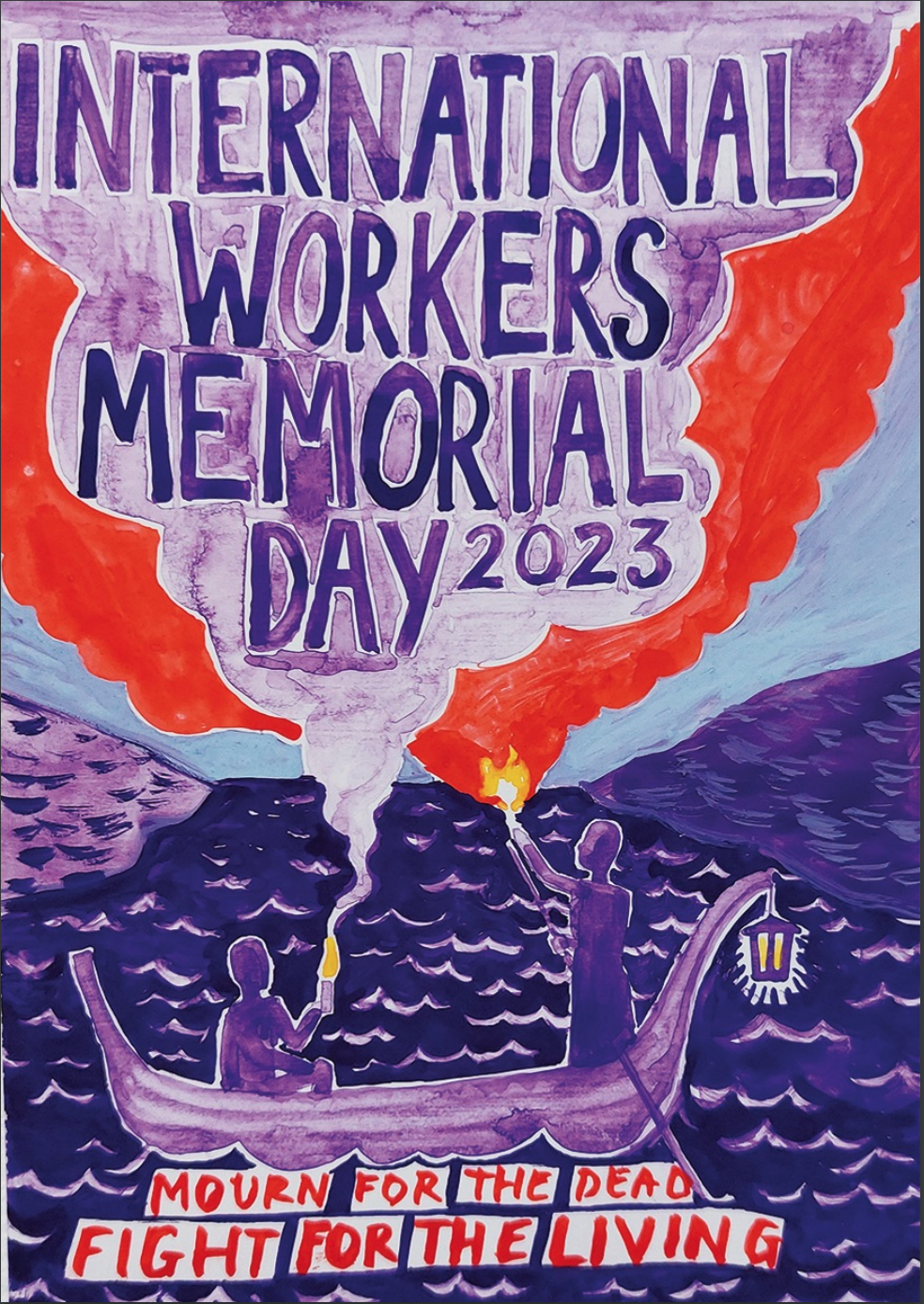
Our zine was titled International Workers Memorial Day 2023, and was distributed at May Day demonstrations in Glasgow and London. We found the subject matter lent itself to an approach that suited our art group’s communicative style, and we also wanted to seriously work through what would be an appropriate response to the theme of memorialisation. A community’s approach to mourning and celebrating life/death signals something important about the attractiveness of its character. How we do this matters. 


For better or worse, there is a cultural tendency to keep certain forms of politics apart from mourning. To make political work about memorialisation, we have to accept some different rules, have to meet grief on its own terms before we can do anything with it that doesn’t appear to rob it. To act politically in relation to memorialisation requires a different sensitivity to the material under consideration. 


The type of intervention we deemed appropriate is what our group understands as non-didactic, what I think of as demonstrating an oblique or diffuse political style. While our group has some definite points of agreement, there are some subjects where vaguely expressed attitudes that capture something of our place in an unfolding dialogue work better. Maybe this can be thought of as a dilemma between holding a ‘political line’ vs cultivating a structure of feeling/‘vibes-based politics’. 


In the case of this specific intervention, we were communicating with an audience composed of people who care enough about the labour movement to attend a May Day demonstration in the UK. It is hopefully understood from our work that we wanted to help people into a more internationalist view of class, and to reckon with the reality of a labour force with divergent needs and priorities. 


In our art, here, we don’t want to take a wholly argumentative or declarative textual approach because, as mentioned, we identify the subject matter as poorly suited to this manner. But additionally, we avoid this style because we believe in making the most from our total ability to communicate. There are people in our movement - or more often on its peripheries - with the skill and desire to communicate in unusual ways, and it's our movement’s loss if we fail to figure how to include their energy in the struggle for a classless society.   


At the same time: I do believe in the need for a confluence of political and stylistic positioning - as in politics so in art - but this should be conjunctural. There’s an Asad Haider article about the Chinese Cultural Revolution that I think gets at this. Haider relates how a plurality of co-existing political experiments during this period of decline in Chinese working class power became strategically necessary (though not wholly sufficient in itself) to overcome counter-revolution. In the UK now, where the capitalist-aligned classes similarly appear to face no singular, leading mass movement coherent or capable enough to surpass them, where there is no mass organisational force and programme around which we must all evidently trend in the same direction, plurality is again the word. 


Probably the most recent situation in the UK that seemed to suggest a large-scale coherence of communist positioning was during the Labour Party’s Corbyn years. Please allow me to divert here into a very quick appraisal of this as a case in point for how politics and art were cohered round a mass movement. 


At its worst, the cultural output of Corbynism’s leading, nascent cultural institutions (The World Transformed, Tribune, Novara Media, Grime4Corbyn), was characterised by a sycophantic, idolising, forced enthusiasm. This may be the style that a closeness to bureaucratic power tends to bring forth. On the fringes, however, were lively experiments taking place amongst Twitter users - most notably, the array of ‘Trevor Bastard Extended Universe’ accounts, which developed a new style of parafiction uniquely suited to the participatory medium and shifts in the balance of political power. The former attempted to inculcate a collective projection into some future idyll of material abundance and comfortable self-governance, the latter focussed on criticising the movement’s antagonists. (I probably missed the best of the worst though, so would welcome hearing more about positive Corbyn-aligned artworks that didn’t end up falling heavily back onto the movement leadership’s icons and slogans.) How Corbynism might have institutionalised this latter cultural tendency had the political fortunes leading up to 2019 been different, is a question we can only dream of answering. I think to be fair this was a radically new situation for many of us, so it was understandable that some of us would try on things that didn’t really fit as part of finding out what would.


That said, it must be clear that developing a style from the fantasy of wielding big institutional power is a bad fit for those of us working through socially progressive organisations and campaigns in 2023. So what is this little zine? How is enough power amassed to realise its political and stylistic aims? Are we interested in power? Should we receive institutional support, from where? 


In its way, a zine such as this can work as a connecting object between different points in a field of actors organising for progressive social causes. One of the most actually prominent, though least recognised, reasons for art’s existence is to serve as an alliance-forming entity that softens differences between factions. Part II in Larry Shiner’s The Invention of Art makes a case for recognising how in the Eighteenth century, art revolved around the “creation of a common arena of high culture and fine art in which the nobility, gentry, and educated middle class could share”. The coalescence of social power blocs into a ruling force can be facilitated by art. Shiner goes on to quote the view of Lord Kames, that “by uniting different ranks in the same elegant pleasures, they [The Fine Arts] promote benevolence; by cherishing love of order, they enforce submission to governance.” I want to tentatively say from this that the outlined social function of art can be applied from any point in the arena of class struggle, and on scales far smaller too.  


So what do we - the makers of this zine - want to coalesce our allies around specifically? As mentioned earlier, part of our intervention comes from a felt need to experiment with styles that are non-didactic, or developing on from this, approaches to communication that are non-analytical. 


We learn from reading artists’ statements and interviews, how art tends to hide the analytical thinking that goes into its making. 


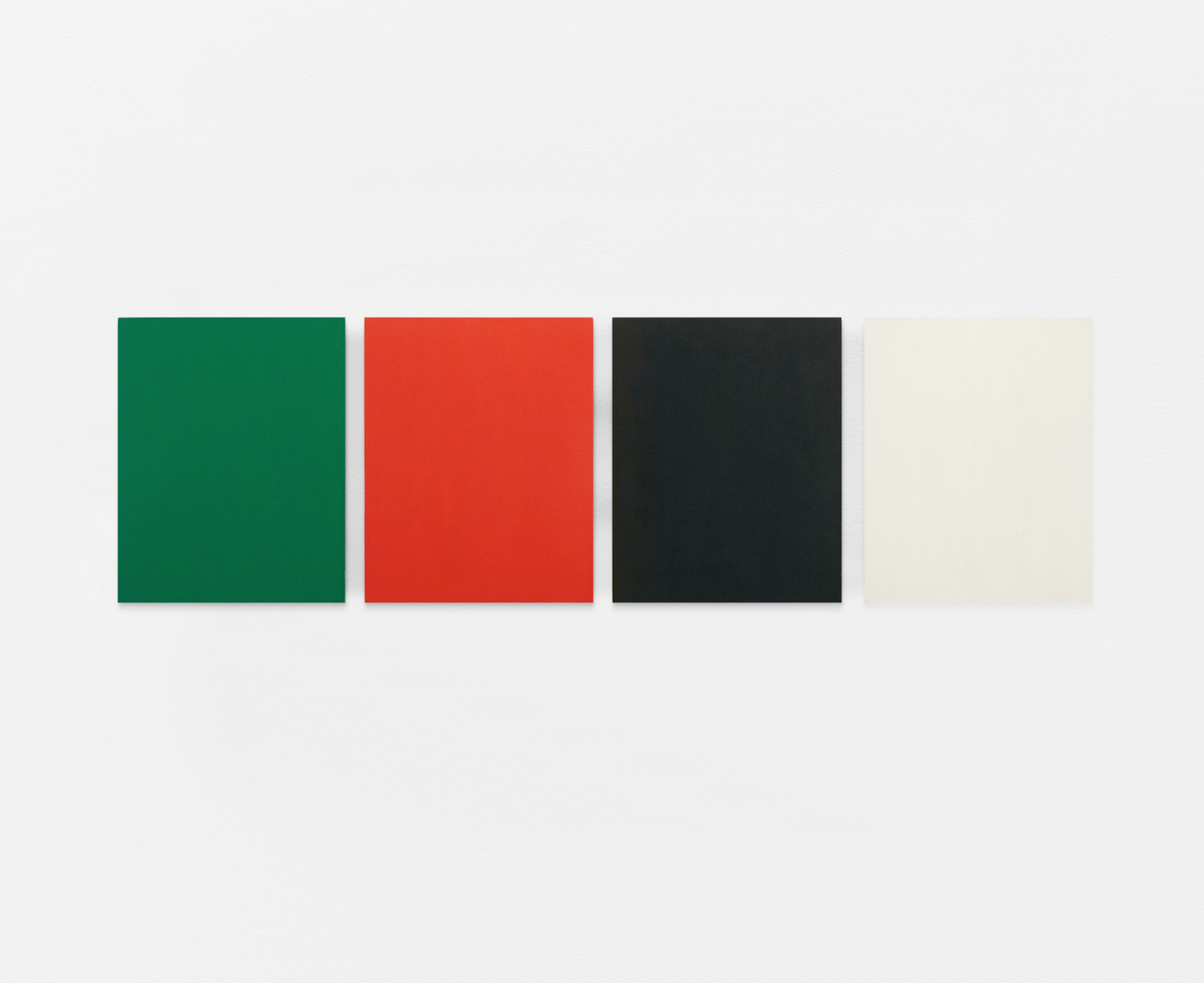
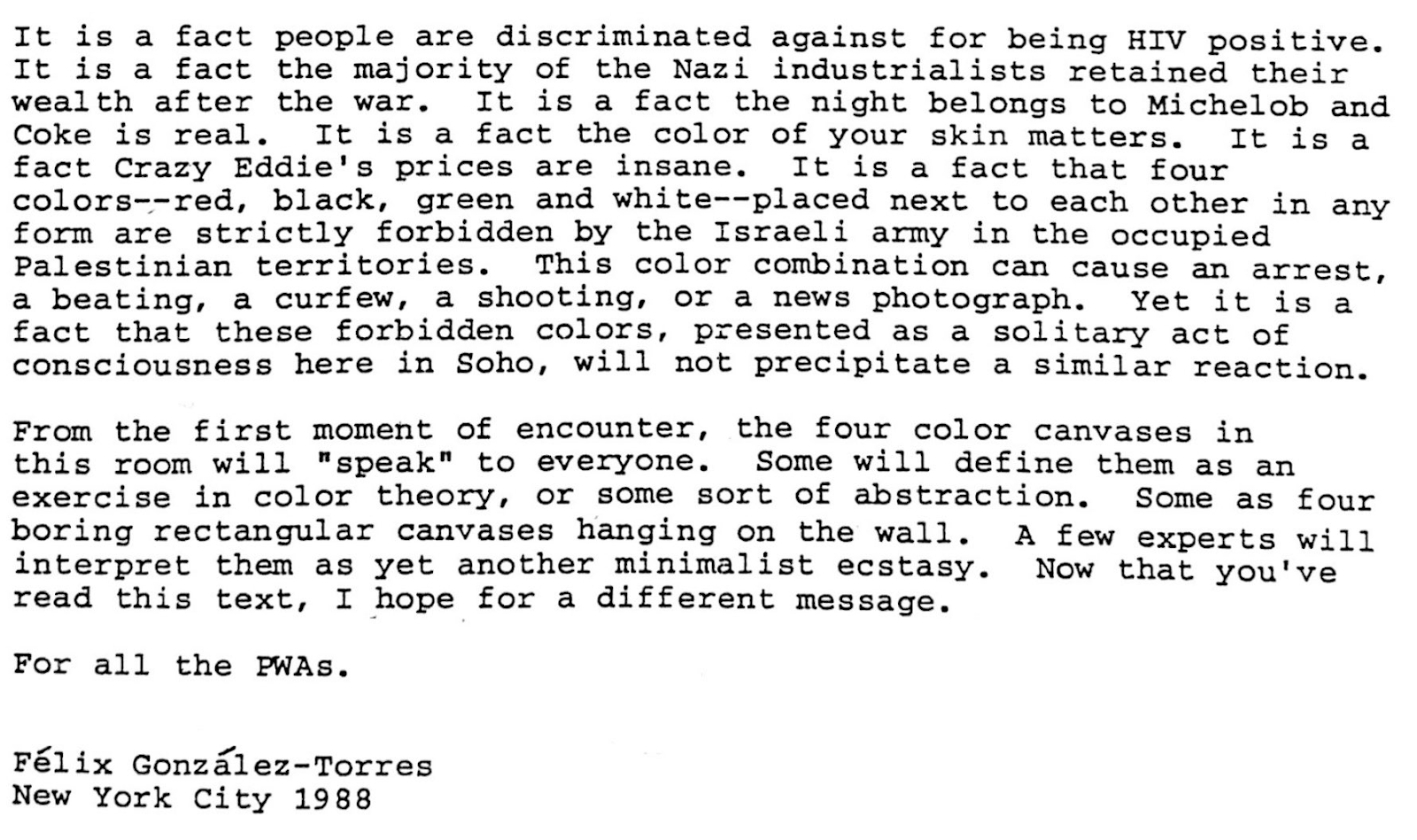
In the case of Conceptual Art, this transposition of analysis into non-analysis is turned into a formal technique of display. The explanatory text is presented as a discrete but fundamentally co-constitutive part of the work. Take for example, Forbidden Colours, by Felix Gonzalez Torres (1988). The accompanying written text demonstrates an adept grasp of analytical language and thought that does not show up in the image he has presented. I’m using this example to quickly present a mechanism that can show up in some art - analysis goes to non-analysis. 


But I would like to suggest that we do not in all cases have to see analysis as some kind of proof that validates an artwork, since there are times when artists work from intuition. A work might legitimately move from non-analysis to non-analysis. Because some artists are more well-suited to working from intuition, they may not generally think or know how to communicate analytically. Analysis, with its basic assumptions about language, is an ill-fit for the style of thought belonging to the historically situated artist-type. (Though we should be careful not to fetishise or exoticise this!) 


My provocation here is that artists don’t find it easy - that to be good with words is an incredible gift. To hold a predisposition for cogent argumentation is like being born in a body that is white or male or holds any other quality that tends to confer social advantage. Perhaps this goes some way to explaining why Hamja Ashan’s book Shy Radicals has been so popular in art circles? Because in speaking to a phenomenon of introversion, it highlights a widespread lack of faith in one’s own ability to speak in concert with the dominant analytical style. 


I believe that how we approach these differences should be a live question for our organisations. Is this difference something to which we should adapt our wider practices, or do we focus on training people into the style? I want to leave that open. 


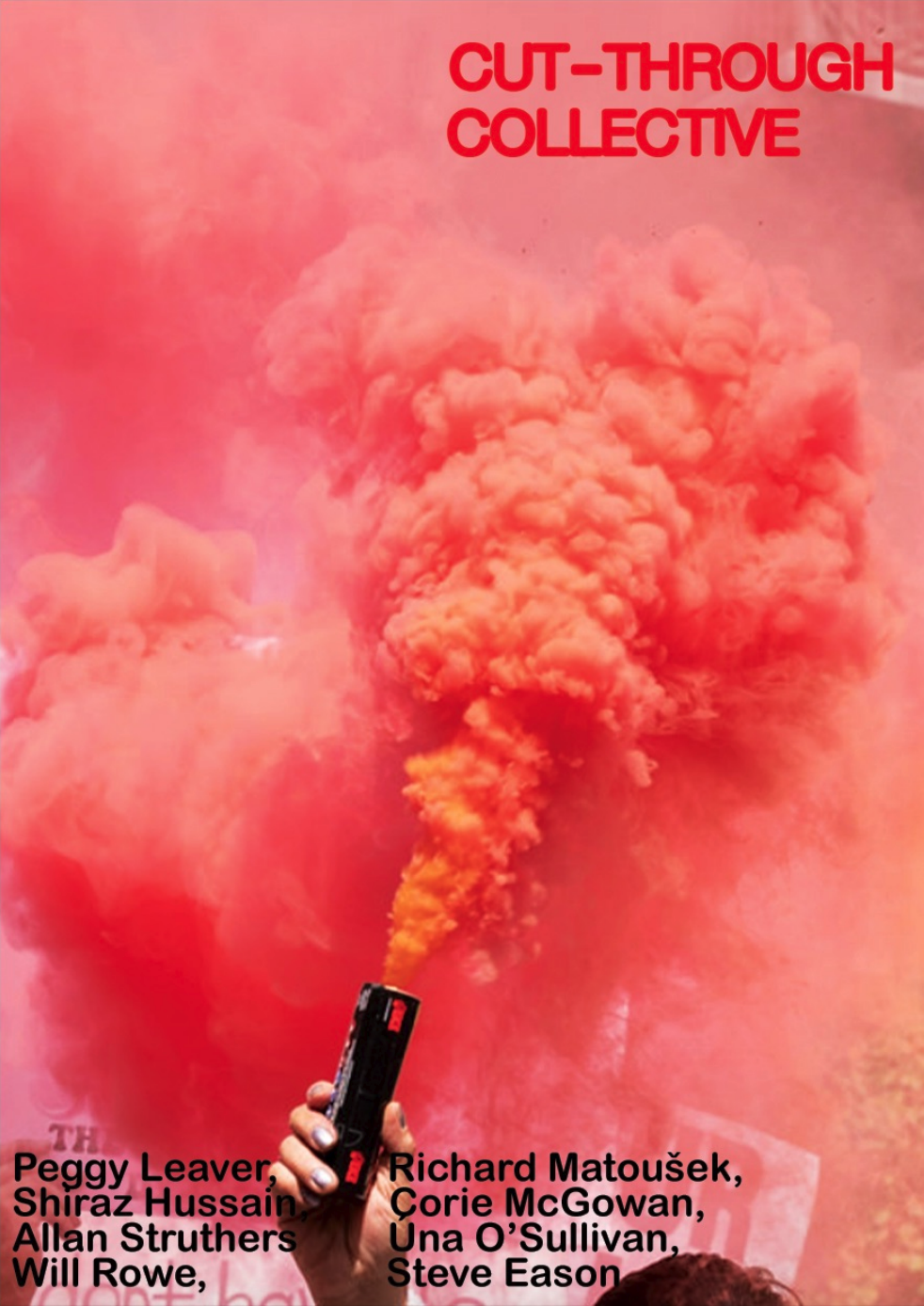
To round off, I think Cut-Through Collective made this zine as part of a project to include different types of communication in the culture of political demonstration. We wanted to experiment with styles that would be appropriate to the subject matter of grief, to our political aims, and our real position in a balance of forces. Finally, we wanted to find and gently shape some points of convergence amidst the extra parliamentary political left.

Monday, June 26, 2023

On ‘Welcome to the future: this strike wave is just the start’ (WR)

https://notesfrombelow.org/article/welcome-future

This is the best thing I’ve read regarding the current political situation. I find its least articulated point to be both the most difficult and the most important one. Expressed as a question, this point would be How, in the current situation and its likely future, to move from economic demands to political ones? The fact of raising this question makes this text an unusual one in a situation where most Left thinking seems to assume that the present task is to build rank-and-file organisation as new layers of workers come into the struggle for a living wage. The
Notes from below text states quite clearly that given that economic growth in the UK is impossible--under current conditions and for the foreseeable future--, real gains by working people will mean taking from one class and giving to another. In other words that the struggle for a decent life is now political, in a way that hasn’t been the experience of living generations.

But the text treats this as an incremental process: over time, workers will discover that employers (including the state) cannot give them what they need and as they do so they will need to organise differently, for instance in committees of reps reaching across several work places. Long spans of the history of workers’ struggles are at stake here, but what I want to draw attention to is something else. That is that the transition from wage demands to political demands is posed as a linear process. Ok, history does not move linearly but in leaps, but like any ‘correct’ statement that falls into banality.

Supposing we think of the curve of workers’ struggles as intersecting with another curve, that of capital. What if capital’s need for growth, in the context of planetary climate crisis, global competition for extractive resources and the geopolitical spread of falling rates of profit, translates into increasingly irrational behaviours of ruling classes? (wars, ecologically destructive industry, Caesarism and fascism in the political). And what if capital’s process is subject to sudden accelerations? (Ukraine war and its lateral outcomes, other present and future wars).

But that kind of language, too, can fall—I was going to say fall into correct description, which is true, but it’s the temporal arc we’re inside of, the intersection of the temporal arcs of subjective struggle and of capital’s infinite greed that is difficult and requires work because the narrative of 20c revolutions is of no use, is merely food for nostalgia or melancholy or for desire of being right. One can speak of tectonic shifts, quantum leaps, but the point is there’s work to be done. Mourning, if that means actually abandoning the thing that’s been lost. What does that look like?

A world lost, a world unsuspected, beckons to new places’. This is W C Williams in ‘The Descent’, a poem from the late 1930s.


Friday, June 9, 2023

One More Time On Damage (DH)


the other city was beautiful: the sky was completely cloudless and the street demonstration was larger and full of red smoke. grass is greener etc. i still felt frustrated, like i always do, that the things that i want to say i can never put right, that the 'stakes' never come across clearly, that i am continually allowing my arguments to be derailed by the minor satisfactions of the crescendo, the hissy fit or rhetorical blowout, tilting at windmills, trying to show off, making a verbal scene. i felt dismayed that the response that i wrote to w had veered off into a display of over-inflated egoistic disappointment that might have felt to him like an attack, when i felt nothing but gratitude to him for the way of his thinking and for the other paths that his thoughts had opened up. i was reading anna mendelssohn's implacable art, which once again seemed to demonstrate to me something fundamental that i have felt and have wanted to get across. 

a few related thoughts have been at the centre of everything that i have recently written. so the following as a kind of abstract (and perhaps also as a provisional full stop): 

(i) i have been trying to articulate for myself the idea of a communist resilience that we can develop in ourselves, a way of being; and along with that comes the longing for a style and a form of thought and a way of speaking in which that mode of being can be expressed implicitly and at every turn, regardless of the particular thing that happens to be being said, or articulated. if we could cultivate that style, i sometimes think, then it would be possible to talk about how to stay alive, how not to abandon ourselves to unhappiness, how to live well alongside one another, how not to get isolated, without those things becoming their own self-sufficient horizons and replacing 'politics' (or class struggle) as the ultimate object of our concern. we would speak more openly and freely, without internalised guilt for addressing the 'wrong' subjects, or abandoning our earlier commitments, and we would be secure in the knowledge that our style and our way of speech (and perhaps finally just *who we are*) would guarantee the connection of our thinking to ultimate ends -- commitments that we no longer even need to name, or identify, or conceptualise, because they are just there in the *way* that we speak, and live. and so we would be liberated from the hateful gut-wrenching sensation of confusion that comes from watching our friends and comrades start to say things that are foul to us, using the language (but not the style) that we too have invested our lives in, and fought for and attempted to define. we would cease to feel as if we were trapped in a kind of labyrinth, in which by following our 'ideas' to their logical conclusions we travel further and further away from the principles that initially motivated them. 'and so / I am only interested in nonexploitative relations between people // the people who sneer at that 'on our side' are not on our side / our side is the people who do not sneer like that / and there are no others sides // only illusions mirages and labyrinths of words / that lead us away from ourselves'. just before i left i saw a friend who said he was only interested in tyrannicide, something else i forget, and modern art. and i recognise this impulse immediately: to retreat to basic principles, to want to find ways not to get lost, to screen out the noise and the confusion and the distractions and the smokescreens and the people who don't interest us. and all of us are going through this same process in different ways, and we are only just beginning to share with one another our thoughts about what it is that we need to do. i want to know what more of my friends have thought to themselves about this problem, to see how it is processed through their own vocabularies and terms of reference. i can feel very painfully the limits of my own.  

(ii) and too many of us have been playing roles in an elite-class game. the system of elite-class writing in its current phase makes a virtue of injury: the speaking subject should be injured. the injury should come from a marginal position, whether of race or class or gender or migration. representation of the group injury as personal experience (= as property) is a condition of entry into the elite class system of representation in the current phase of its management of group injuries that it presides over and inflicts. the representation-game i am talking about increases the resilience of that system, and turns ramifying collective losses to its own spectacular advantage. it has been hegemonic in the 'cultural sphere' in roughly the period 2013 to today, which means: in more or less the same period in which global economic crisis was remedied by means of mass economic austerities and bureaucratic state violence. (but i'm not pointing fingers. we've all played it.)

(iii) that's a specimen of 'analysis'. the person who i was thinking of when i wrote it is dead now, which means that it probably isn't sufficient...  'the communist party is not a big clean party', wrote p-p pasolini, 'it is a big dirty party; but it is dirty with the oil of the shop, with metal, with rust, flour, dried fish, blood, mint, sweat, and dust'. and sometimes i think what we really need is a canon. writers who have tried to bring their ideas closer to damaged and injured ('dirty') people (including themselves) include andrei platonov, pasolini, ivan illich, anna mendelssohn, m. e. o'brien ('junkie communism'), verity spott ('that horrible burning religion') and william blake. the 'dirty party', the idea of revolutionary harm reduction, of convivial technology, of the marriage of heaven and hell -- all of these notions point towards a style of thinking in which grand revolutionary transformation belongs to the damaged and resembles them, *rather than vice versa*, and in which damage and injury are *inescapable starting points* and not moral virtues for their own sake: the goal then is still emphatically to create the new social order, but one that the damaged and the injured *in this world* are themselves able to control and comprehend. there are snatches of romanian and polish in it, of bengali and salt-sea, incense and fishblood and weed smoke in arcades: obviously it all depends on exactly where you come from. but there are also other things as well: arguments, visions, utopias. the thing that we want does not come solely from the future. it does not gleam. it is not at the cutting edge. 

(iv) the emergence of an elite class game of injury-representation does not reduce or ameliorate group injury, but is continuous with the processes that inflict it in the first place: ok sure, but also *the lucid recognition of this reality is not enough to help us to endure*. the people who taught me to recognise it themselves seem pretty fucked up right now, have become confused, isolated or cut off, unable to situate themselves in the present in which the ideas they once articulated are taken up by the mass culture and twisted spitefully against them. it seems really obvious to me that they lack the resources to survive, and i think now that part of the problem is that they didn't develop a style, a way of being that would allow them to go after those resources without feeling that they were abandoning their basic conviction that everything had to change before their own condition did, or could, or might. 'we play our lives like pieces of music', somebody writes. 'We know that a perfect score exists, but we can't read it; and the hesitant discordant melody that we do execute is in the end the only access we have to the music of our lives as we know that it really is'.        

(iv) i think that probably most of us who love poetry have the conviction that there is one bit or snatch or line of it that seems to define everything else and to encompass it: a kind of ur-poetry, possessing an almost metaphysical significance. for me those lines have always been the ones from william blake's 'london': '[i] mark in every face i meet / marks of weakness, marks of woe'. and i mean it. i come back to those words every single day, like a mantra. they encapsulate for me the task of poetry and a basic challenge to 'my' politics, to my belief that things can change, that they don't have to be like this. and the struggle as i have felt it has always been to understand *in what sense the lines can be true*, in what sense the 'marks' (which i have always felt must be *indelible*) can be real, without the belief that things can change being proved false, or illusory; and it's only pretty recently that i've begun to feel as if i have a way of answering that question. try it like this. imagine a universe in which these lines of blake's are the centre and project outwards invisible fields of force, invisible lines of gravity within which everything else is located: 'the class struggle', economic reforms, principles of hope, going to work, reading the news, producing art, 'reproducing yourself'. shit like that. and we don't 'talk' about these fields, but everything that we *do* talk about moves within them insensibly: pasolini's rust and fish and dried blood and smoke in the air and our ideas about 'communism' all move within this forcefield that blake's lines define, and delineate. so the point is that when these marks of weakness, marks of woe are thought or felt like this *they don't rule anything else out*, the fact of their irremediability does not rule out revolution or happiness or, i don't know, whatever you like, transcendence, renewal, jfc even spiritual insight if you want it, they just don't, and the borders and walls and inner citadels of 'real injury' outside of which everything else is just pipe dreams and adolescent fantasies crumble like 'Cathedrals ... based on symmetry which later becomes magmatic, abnormal and out of proportion'. nothing is ruled out, nothing is destroyed, nothing left behind, we play the notes of our life in the wrong order, and somehow we still hear the music as it really is, even though it can only ever exist like this, in the way that we're playing it right now: misphrased, discordant, a little slow, a little hesitant. and everything is the same and everything is different, and we are travelling backwards in time towards a thing that no one has ever seen before: and when i started writing these notes a few months ago i wanted to talk about what had gone wrong, i had the feeling that so many of us had lost our way, that the damage was accumulating but that we didn't know how to get it into words (I don't mean with 'professionals'), that even the act of opening our mouths to talk about ourselves would fill us with unwanted invasive feelings of guilt, and now it's six months later and i'm starting to feel like i've turned a corner, as if i've finally understood something basic and something has clicked or become clear: that blake's universe of woe and weakness is really just a set of rules, as indifferent and as mild and as neutral as electromagnetism, or gravity, or multiplication, and it is only when it ceases to be the substance of our style and our way of being that it becomes unbearable and stops us from thinking; but when it exists in our style or way of being everything else becomes possible again, we can go back to our political ideas and see them in a new light, changed but also persistent, and enduring, and for the first time in our life maybe they really seem like *our* ideas too, like things which are coming towards *us*, as the planets move towards the objects at the centre of their orbits; and maybe this feels good? to no longer have to chase after *them*, feeling ourselves getting weaker and weaker, and less and less able to remember why it is that we started, and looking up sometimes and seeing them always further and further away? i don't know, you tell me. we all know that when a new chapter of our lives begins, it'll have to be lived day by day: and there are notes that none of us have been able to play, and we hear them anyway in the notes that we are able to play, and do. perhaps even here.

Thursday, May 25, 2023

Report on meeting at MayDay Rooms, 10 May 2023


We met at MayDay Rooms. The conversation as minuted below has the character of most collective discussions – it is digressive and represents several simultaneous ‘tempos’ of thought and argument, as people return to previous contributions or branch off in new directions. Via the discussion of Berger on ‘living with the dead’ in the images of Marketa Luskacova, much of the talk circled around questions of commemoration and mass death. There were difficult moments in this exchange. Tempers frayed and some of the participants became visibly frustrated. Hard to know how to describe this. Some of us felt more personally involved with the material under discussion than others. Distinct lattices of emotional connection or relevance underlay a conversation that could seem speculative, ‘high level’ and digressive. What feels like an innocent question to one person is perceived as an act of almost deliberate carelessness to another. Possibly a central tension arose between the language of ‘politics’ and the language of ‘ethics’: the two modes contend over the experienced reality (the ‘territory’) of death, and each contests the claims of the other. What are the limits of ‘politics’? What are the limits of ‘ethics’? Perhaps neither is adequate: but then the question wasn’t framed at the meeting in these terms anyway. We ended with thoughts about the unbound/inarticulate/unspeakable.   

  • Lundi Matin piece: <https://lundi.am/Pour>. We began by reading this: ‘The shrink, psychoanalyst, psychotherapist, let's call him what we want, insofar as he doesn't just give medication, and he listens to us, has recently entered our lives in a more collective way. Until now, you had to have been marked by something in life, have symptoms that you never talked about, bad half-shameful childhood stories – for this experience to be imposed, for you to be forced to 'go. We had that space somewhere in his private life. It was the space of the care of private life and memory and of a certain form of individual cursing – except for the intellectuals who thought they were learning interesting and enriching things about their castration or filiation problem. I simplify. For some time, since the pandemic but even before, for a few years the lines have become blurred and we have been less successful, we have no longer succeeded too much in making the difference between personal pain and collective pain; between psychic pain and political destruction. Each and everyone slowly started going crazy, crazy. We have witnessed an evolution of society and murderous capitalism, we have become more or less voluntary seismographs of an evil whose consciousness has crossed the layers of the psyche to go very, very deep within us. inside. Consciousness failed to prevent penetration into the deeper layers. With the destruction of society and the explosion of death drives during the period of great unbinding of the pandemic (social unbinding/digital overcommunication), psychic life took on another place. She found herself overexposed at the same time as social life closed. It would be necessary to be able to define this place: it manifests itself rather negatively, by definitive acts, decompensations, depressive and anxious symptoms, but also, just afterwards, just next to it, by a kind of affirmation which passes through the passivity of the disease only by the psychic action on the world, that is to say by affects, conflicts, dreams, irrepressible expressions, passions and accelerations, an awareness of oneself, of life and of sudden death intensified, of friendship and love like we've never been closer. As if we had never been so emotionally and collectively close to things, never so fragile and sensitive.’

  • Yes, that seems helpful to me. Usefulness of thinking about unbinding. There’s the sense of the end of the ‘defend Russia’ perspective as one point of political confusion, but also the background of unbinding from political meanings in relation to the experience of mass death during the Pandemic.  

  • Re: The Luskacova photos of Spitalfields differ from the images discussed in the Berger. Implicit injunction: Don’t make these images homogeneous with your experience of time, your time. Otherwise they might be compatible with liberalism – ideas of pity, preconceived ideas of class. Where does the injunction come from? From the subjects of the photos themselves; sometimes from their eyes, sometimes not. This has to do with emotion that hasn’t yet been processed into regularised meanings.   

  • The images were taken in a flea market that was outside the normal terms of control and administration. 

  • Is it about the photographer imposing this view? What is the best language for the relation between photographer and subject? Is it one that involves the agency of the subjects? Perhaps that language is also meaningless. In some of the images you can see a positive interest on the part of the photographer - for instance when some of the subjects think they are being photographed and ‘posing’ but the focus is on others. 

  • Relative to the Killip photographs – the images are more interested in composition and those compositions include some kind of message that can be deciphered. Less so in the Luskacova, where what we see is the people in themselves. 

  • Berger: ‘the people trusted her, more than that they allowed her to become intimate’. 

  • In the Spitalfields images – possible to feel some nostalgia for a life I didn’t live. But is the relationship Berger describes between the photographed and the dead also relevant for the Spitalfields images? Is this to do with peasant life? 

  • People living in the streets in these images will have been closer to death or more intimate with death than others. 

  • Berger suggests the images fail when people have an interest in seeing themselves as they are – it is their lack of concern with the photographer that allows the images to succeed. 

  • [Attempting to step back and introduce more general considerations:] thinking about the meaning of ‘forgotten political experience’ – Audre Lorde as discussed by Gail Lewis and ‘world-sense’. Is there something in how the people Luskacova photographs in Pilgrims that could remind us of pieces of our history that we have forgotten. What about the ‘loosening of the oneness of the self’, not in favour of a specific collectivity, but some much larger thing. The photographers take time ‘not to be thought of outsiders’ – a dwelling together. The question of the forces that make it difficult for us to speak to one another, raised on the Reports blog – to speak with one another with various measures of openness. We are testing out with one another what and how much we can say about the different areas of the left. 

  • If you are dwelling with the dead as Berger suggests that one might, it is harder to hold on to an idea of one’s total difference or uniqueness. The connection here again to the Gail Lewis piece. 

  • If contra Berger’s peasant society, we have been through a mass death event and live in a society that refuses or disallows commemoration, perhaps we should avoid noting similarity or continuity.

  • What would it mean for us to be in some relation to the dead? To avoid remembering as a scanning backwards towards a static past defined in relation to a static now? How to be in any relation to the many dead? 

  • I see two approaches to commemoration - a simple and a complex approach. The images Berger writes about are complex. Simple approach: the Vietnam war memorial in the USA. A simple shape and then names are added to the structure. A similar project for trees that had died due to climate change. The dead trees are left to rot in public parks. Something is made visible in simple terms. Does this approach help? Hard to think dialectically about this. 

  • There’s something about listing names that doesn’t reach to individual experiences of death. There’s something about not knowing people’s names and still wanting and needing to have a kind of relation to what’s happening. I think of the NGO-maintained list of the names of the people who have died due to Fortress Europe border policies. Many people in this list were never unidentified. A commonality in the absence of being able to form a relation – I question the need for names and details of individuals. What can be done with states of anonymity, or with people who are not known, not identifiable?

  • The relationship between numbers and names – during the pandemic, you got the numbers every day. What was this about? If it’s remembering, it’s a hyperrational and secularised form. Naming *as* counting.    

  • Liberalism tends to get hung up on raw material data relating to an atrocity, rather than meaning. 

  • I think for instance of the clearance of people by brute force from Scotland and parts of Ireland during the eighteenth century. I don’t share the scepticism about numbers. I think we need to know how many families were shipped overnight to Newfoundland or Australia. I think we do need to know this. 

  • I recently saw the Steve McQueen film about Grenfell at the Serpentine. McQueen grew up in the area; before the building was covered in its current cladding, he filmed it, homing in from the affluent districts in the north. The sound drops away as the camera reaches the tower. Names aren’t included in the video but they are on the wall in the next room. This piece and his work about Grenada seem extremely strong as approaches to this issue of the closeness of death and how to be in real contact with it. 

  • Relation to the exemplary individual death - Alan Kurdi on the Turkish coast. That kind of liberal piety. But also the relation of this to the mass movement and its martyrology – US 2021, Iran 2022, Tunisia, Egypt etc. 

  • I want to defend naming – a way of making proximity to the dead. Naming is a fundamental linguistic process. Maybe it doesn’t matter if it’s also done in the NYT. Do we want a secular way of relating to the dead?  

  • There’s a question of responsibility here    

  • Death is the programme of austerity – does this create a sense in which it is unjustifiable to be alive, in some way? Obviously that is a sensitive thought – needs to be discussed carefully. Lisa and Danny’s conversation on Sean’s Our Death. 

  • How can we name no one when we’ve made so many people no one? We can’t name no one, said Celan. Why always the focus on covid when so many people are dying at sea etc. It makes me angry.  

  • There’s always the ‘say her name’ BLM chant/slogan. 

  • I find the naming more meaningful when it is etched on the faces of the living and not onto dead material.

  • Who do we preserve things for? Do the subjects of the photographs care? I don’t know…

  • What about the Weiss quote? ‘Later, after we achieved political understanding, our hatred grew more intense, we began purposefully fighting those who tried to hold us down, annihilate us. We were guided by a cold, homicidal repulsion. Very seldom did we find this sensation articulated in art, in literature’ – is there a way of thinking about the relationship to Luskacova? 

  • Worth thinking about the materiality of film - the light entering the lens, leaving a mark on the film. Different with digital photography, also with memory. You lose the physicality of the imprint. It’s harder to erase film. Abundance wipes out meaning. Is there a sense in which the images are ‘homicidal’ in Weiss’s sense – in relation to the working class? And perhaps in relation to their subjects, also – poverty is also a form of annihilation.

  • [there is a difficult passage of the conversation here: some participants respond with pain to the idea of the word ‘homicidal’ being in any way relevant to Luskacova’s images]

  • Where might they be shown? The idea of them being shown at the Tate aggravates me. 

  • Two photographers working on Ridley Road – trying to collaborate with people and give them power *or* preemptively memorialising people who are in fact still alive? The photographer can make choices; these are political.   

  • Photography needs to be a part of a political struggle – to enter into political struggle. 

  • I feel the same, but it might be the case that what some photographs do – we haven’t found the forms of struggle that are needed. To read off the ‘political potential’ of photographs might miss what they are calling on us to feel, think and do. 

  • The video of George Floyd’s murder had political power and helped to sustain momentum. 

  • But these were also videos of murder - as images in this genre always are. The photographs are in a complex way helping people to survive. Feeling, thinking and doing are important verbs – what about being? The Pasolini essay on the being of the faces of his subjects. The Gospel of St Matthew: the almost transcendental relationship to the face. Also the history of the Italian subjects – the beings – who Pasolini was filming. 

  • This is helpful in that it brings back the question from the beginning, of relation to one’s own political thinking. It’s about not just changing your thinking but also changing who you are.

  • The question of co-optation – what does it mean if the images are shown at the Tate. But don’t we want those people to visit the Tate to change also? (The exhibition was free.)

  • I still don’t think it’s useful to talk about Luskacova’s images in terms of their political potential – they record something as yet unarticulated in politics, unavailable to politics.

  • [Some disagreement about this.]

  • Maybe worth thinking about when they were taken – in the late 70s, before mass gentrification. Politics perhaps has more vocabulary + forms now for what Luskacova was doing. 

  • The images represent a not-yet space, like in the Gail Lewis text: art can do this. 

  • A big portion of the present situation is not intelligible. 

  • The relationship between the need for patience to get at Weiss’ ‘babble’ and the urgency of the situation. A contradiction that can’t be wished away. 

  • There’s a lot of unspeakable feeling that is entwined with but not the same as the social – the question of unbinding. 

  • Capitalism brainwashes us into thinking trauma etc. are individual issues when they’re not. Portraiture is not bourgeois because the individual is not individual. 

  • ‘It, the language, remains, not lost, yes, in spite of everything, but it had to pass through its own answerlessness, its own muting … it had passed through this happening. Passed through and had come to light again (Celan); Aichinger: ‘I have only one language and it’s not mine. Language is something that does not belong’.     


Proposals for next time: 


  • Pasolini’s poem ‘Victory’, on the dead and the problems of politics and of being. 

  • Text by Lis Rhodes of the London filmmakers’ co-op on history.


Response to a response ['On Denial'] [DH]


[A response to this, which is a response to this]


Dear Will,

Thank you for responding, for opening this up into a conversation. I think you’re right to push us back towards things that are actually happening: the ‘conditions which determine our situation’. Those are the hardest things to talk about, but I’ll try at least to follow you in their direction.
 

You say that there are damage-events that are denied that nevertheless
can be expressed, but only by ‘thought-figures’ that are strictly ‘non-exchangeable’. It follows from this (clearly) that these are difficult to analyse, or even just to name. If they do emerge into a common and transmittable vocabulary, they are no longer fully perceived. Your finger is chopped off in a poorly lit factory. You name that experience an experience of class. But this thought-figure of class is exchangeable almost by definition, and this creates a political problem that is itself difficult to talk about, and easy to deny (I’d be really happy if you would say more about your thinking about this.)   

So what is that ‘political problem’? Partly it’s that in demanding that our own damage-events be taken up into shared political language, we get stuck in a cycle of misrecognition. In this case, we need the basic concepts of shared political analysis
to do something that they were never intended to do, which is to address the innermost recesses of our individual experiences of loss, or grief. I’ve seen what happens in that cycle. People double down into endless attempts to extort from their shared language a kind of personal recognition, of their ‘own’ personal damage-event (lost fingers literal and figurative), as if they were trying to win damages in the small claims court of their own private interiority. And there is (as you put it) some minor ‘satisfaction’ here, in the feeling that your pain is inexpressible in our language, a reassuring sense of personal distinction -- but pretty inevitably that satisfaction drifts off in the direction of quietism, or reactionary thinking, or a cocktail of both, a species of banal would-be-aristocratic anti-politics in which there is nothing but pain, glittering and seductively irremediable. Sometimes this is me. A friend writes: ‘I remember thinking once that to be a communist you'd have to believe people could change’. And I think I now believe that dignity is a big part of the problem, that the tacit claim that ‘your’ pain confers dignity on you, and allows you to make special kinds of demands, is a LIE, and that the idea your pain should be respected and dignified is a ANOTHER LIE, and that the general assumption that ‘political ideas’ are obliged to wear tuxedos and carry your pain around like some kind of funeral bier is A WORTHLESS LIE and needs to be TRODDEN UNDERFOOT like those stupid tuxedoes themselves and all of the hierarchical yearnings they represent. Shit is inexpressible, and ‘political concepts’ are always flimsy and gossamerlike, but I would rather parade through the street in them laughing at my nakedness than take them to fucking court for damages. Humourlessness will destroy us. 

Towards the end of your letter you talk about Rimbaud’s unbinding as a ‘basic element of Leftist tradition: to break all moorings’. You also say that we presently
feel unmoored, that this unmooring is the default, and that we ‘should acknowledge the unmooring of ideas from their historical basis, right down to the linkage of words in their phrasing’. This recalls to my mind Stephen Hastings-King’s metaphor in the text we discussed in our first MDR meeting: ‘we float’, SH-K wrote, ‘like plankton … near the surface of an online sea’. And so unmooring itself becomes unmoored, is no longer a call to rebellion as radical subjective unbinding. And the unmooring that seems nearest to us is not the unmooring we know from Rimbaud but the one that was immortalised in Mayakovsky’s suicide poem (in which ‘the love boat has smashed against convention’), or the devastatingly prosaic unmooring of tiny isolated floating organisms which serve as food for larger and more complex systems. Capital, for example.

‘Plankton, meaning to drift, or wander in a sea’.

So, is this part of what at the end of your letter you call ‘confusion’: that we no longer know what it means to ‘rebel’?  The mark made on our intellectual lives by years of fascist provocation is obviously relevant here, but there are other things at stake too. In the first draft of the reply I wrote to you, I finished by saying that ‘for a long time I've felt really sick, and now I feel less so, and I want to try to talk about why’. I’ve been thinking a lot recently about Ernst Bloch’s
The Principle of Hope, this giant luminescent encyclopaedia of images of the other world scattered through human history in fairytales and myths and scientific theories and music. Yesterday when I first tried to get down my response, I made an attempt to talk about this ‘hope’ in terms of space, and poetry. I wrote about Satan’s passage through chaos in Paradise Lost, and Pasolini’s ‘Testimony’ in which he describes walking ‘all night long’ through filthy suburbs in search of sex (‘the sex is a pretext’, he says), and about Alice Rahon, who says that ‘for a while now, I’ve lived inside a map on the wall’. And that wasn’t wrong, exactly, but the emphasis isn’t in the right place. What I want to describe to you is a feeling that there isn’t space anymore, that there isn’t space for us to think, that all of the available positions have been occupied already by something foul and that wherever we go we find ourselves in the same cramped room, surrounded by our enemies. And when in your email you point out to me that grifting conservative psychologists also instruct us ‘to accept the challenge of life’ (as, in one of my proselytising moods, I might also have done) I feel a trace of this claustrophobia rise up in me again, a thin sheet of panic that has been working its way through my body for years now, and which acquires another layer every time I try to think about what 'radical politics' is: and always there’s this sense that I’m standing in the middle of a room surrounded by people who I can’t bear, and if I try to move away from one person I move closer to another, and the doors on either side of the room are marked ‘acceptance’ and ‘denial’, and both lead into another identical room where the same problem is repeated.   

I said earlier that I want personal pain to be undignified, that I want to accept (not to
deny) that political concepts will cover it badly, that I want to accept that the pain will stick out or bulge in ways that seem unseemly or gross or ridiculous. I said that I want to find that fucking funny and for the comedy to be as it were ‘communally recognised’, and not a grounds for personal affront or retreat into vast vanilla terrain (a green area?) of aristocratic interior self-regard, disdain for mass politics, educated immunity to illusion etc. ‘For a long time I've felt really sick, and now I feel less so, and I want to try to talk about why’. And clearly this is a thought about how things fit together or don’t, and about what it means to talk about ‘coherence’, or ‘cohesiveness’. I’ve been reflecting alongside Bloch on the way Pier Paolo Pasolini could say the most reactionary things and yet expect them to mean something different to what they seemed to mean, because poetry in his conception opens up into the unexpected space inside of our own bodies and in political parties and suburbs and the ideas of reactionaries and teenage boys as well as Communists and mothers and lovers and streets, because he still knew how to rebel, or maybe just because he wasn’t afflicted by this mindless claustrophobia like us, which we only call ‘confusion’ because we’ve forgotten that there is something that needs to be done beyond organising concepts in their relations to each another, and because we no longer see that the more organised these concepts become the more ‘confused’ we tend to be, because each of them becomes more and more like a point on a grid or a node in a system of coordinates that have no internal dimensions and no field of possibilities and so no fucking principle of hope either. And we are trapped inside of those points, feeling claustrophobic and confused, wondering whether we should have started another one of those nice abstract conversations about feelings. THERE IS NO OUTSIDE TO INJURY, I write, thoughtfully.   

So at least now we have a list of terms. Incoherence, confusion – and claustrophobia. I'm tempted to say that we also have a list of counter-terms (coherence, lucidity, ability to move), but that feels too convenient and anyway like I say excessive 'coherence' is an aspect of claustrophobia and not its antidote. Rather I think the point should be about finding a way to move backwards through the sequence, from claustrophobia through confusion and back out again into the 'incoherence of life' where space opens up inside of things unexpectedly and it's a part of our (one might call it) 'intellectual training' to prepare ourselves -- meaning, to make sure we're ready when it happens. 

(Is this also the human basis for something like community justice: the ability to see the space opening up inside of people who are traversed by violence, or in whom we mark Blake's marks of weakness, marks of woe. I mean the ones for whom the reality of injury cannot be denied. I don't know what I think about this.)       

And can I try to lever a question out of all this. Is it possible to talk, Will, about the very large things that you mention at the end of your letter – ‘wars in Europe and the middle east; resurgence of oil and arms industries; postponement of any real, state-level action to resolve climate crisis; inability of states and ruling classes to guarantee survival; political chaos’ – or to oppose them – without feeling like that
they are themselves the walls that are closing in, the answers that have been poured like concrete into their questions, the wall of convention that Mayakovsky’s love boat smashes into? If I feel less mentally ‘sick’ now than I did (and if I keep repeating this it's because I want to convince myself that it’s true), it’s because I’ve stopped screaming at myself. I have stopped telling myself to piece things together. I am trying to meet things differently, to ask different questions of them. I don’t ask them to behave like keys. Does this make sense? ‘To know how to recognise and pick up the signs of power we are awaiting, which are everywhere’ (Tristan Tzara) -- and specifically Tzara says to pick them up, like radio signals in the air, rather than to bend them out of shape like picks for a self-invented lock in a single self-imposed theoretical door. I know this must sound stupidly obvious. But it is a principle of hope for me.   

D


***


undispatch from ny

  i am on that non-verbal gerbil wheel amaretto        and i've often also been there for years now, too many count spitting in the     ...